"To some people, not caring is supposed to be cool, commenting is more
interesting than doing, and everything is judged and then disposed of
in, like, five minutes. I'm not interested in those kinds of people. I
like the person who commits and goes all in and takes big swings and
then maybe fails or looks stupid; who jumps and falls down, rather than
the person who points at the person who fell, and laughs." Amy Poehler, via http://www.elle.com/culture/celebrities/a6/amy-poehler-women-in-tv-2014-interview/
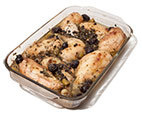
To save time and boost flavor, we ditched the original marinade and
made a paste of the prunes, olives, capers, garlic, and oregano, which
we spread on the chicken and caramelized into the sauce. To boost
meatiness and complexity, we added anchovies and pepper flakes and
browned the chicken skin in a skillet before baking it through.
Serves 4 to 6
Any combination of split breasts and leg quarters can be used in this recipe.
Ingredients:
Paste
1/3
cup pitted green olives, rinsed1/3
cup pitted prunes3
tablespoons extra-virgin olive oil4
garlic cloves, peeled
2
tablespoons capers, rinsed
3
anchovy fillets, rinsed
1/2
teaspoon dried oregano
1/2
teaspoon pepper
1/4
teaspoon kosher salt
Pinch red pepper flakes Chicken
2 1/2 - 3
pounds bone-in, skin-on split chicken breasts and/or leg quarters, trimmed
Kosher salt and pepper
2
teaspoons olive oil
3/4
cup low-sodium chicken broth
1/3
cup white wine
1/3
cup pitted green olives, rinsed and halved
1
tablespoon capers, rinsed
2
bay leaves
1/3
cup pitted prunes, chopped coarse
1
tablespoon unsalted butter
1
teaspoon red wine vinegar
2
tablespoons minced fresh parsley
Preparation:
FOR THE PASTE: Adjust oven rack to middle
position and heat oven to 400 degrees. Pulse all ingredients in food
processor until finely chopped, about ten 1-second pulses. Scrape down
bowl and continue to process until mostly smooth, 1 to 2 minutes.
Transfer to bowl. (Paste can be refrigerated for up to 24 hours.)
FOR THE CHICKEN: Pat chicken dry with paper towels. Sprinkle chicken pieces with 1½ teaspoons salt and season with pepper.
Heat oil in 12-inch skillet over medium-high heat
until just smoking. Add chicken, skin side down, and cook without
moving it until well browned, 5 to 8 minutes. Transfer chicken to large
plate. Drain off all but 1 teaspoon fat from skillet and return to
medium-low heat.
Add 1/3 cup paste to skillet and cook, stirring
constantly, until fragrant and fond forms on pan bottom, 1 to 2 minutes.
Stir in broth, wine, olives, capers, and bay leaves, scraping up any
browned bits. Return chicken to pan, skin side up (skin should be above
surface of liquid), and roast, uncovered, for 15 minutes.
Remove skillet from oven and use back of spoon to
spread remaining paste over chicken pieces; sprinkle prunes around
chicken. Continue to roast until paste begins to brown, breasts register
160 degrees, and leg quarters register 175 degrees, 7 to 12 minutes
longer.
Transfer chicken to serving platter and tent
loosely with aluminum foil. Remove bay leaves from sauce and whisk in
butter, vinegar, and 1 tablespoon parsley; season with salt and pepper
to taste. Pour sauce around chicken, sprinkle with remaining 1
tablespoon parsley, and serve.
Technique
Making Over Marbella
The original chicken Marbella featured chicken parts marinated overnight and then baked.
Problem: Pale, flabby skin Solutions: Ditch the marinade since it turns skin
soggy (and never permeates the flesh anyway). Sear the chicken to crisp
the skin before adding liquid. Problem: Bland meat Solution: Smear a potent paste of capers, garlic,
anchovies, olives, prunes, oregano, and red pepper flakes onto the
chicken after it is seared. Problem: Overly sweet, lackluster sauce Solutions: Eliminate brown sugar and use the
flavorful fond from searing the chicken (plus more caper-prune-olive
paste) to form the base of the sauce. Balance the flavors with butter,
vinegar, and parsley.
To create an Almond Cake with a great appearance and superior almond
flavor, we used finely ground almonds, which had a more pronounced
almond flavor than almond paste, which is used in most cake recipes. And
to create a light cake with a moist open crumb, we used the protein
structure of eggs in place of the denser gluten structure created from
using all-purpose flour.
Best Almond Cake
To perfect this elegant European dessert, we deepened its flavor
and lightened its texture—and did it all in a food processor.
Serves 8 to 10
If you can’t find blanched sliced almonds, grind slivered almonds for
the batter and use unblanched sliced almonds for the topping. Serve
plain or with Orange Crème Fraîche (see related content).
Ingredients
1 1/2
cups plus 1/3 cup blanched sliced almonds, toasted
3/4
cup (3 3/4 ounces) all-purpose flour
3/4
teaspoon salt
1/4
teaspoon baking powder
1/8
teaspoon baking soda
4
large eggs
1 1/4
cups (8 3/4 ounces) plus 2 tablespoons sugar
1
tablespoon plus 1/2 teaspoon grated lemon zest (2 lemons)
3/4
teaspoon almond extract
5
tablespoons unsalted butter, melted
1/3
cup vegetable oil
Instructions
Adjust oven rack to middle position and heat
oven to 300 degrees. Grease 9-inch round cake
pan and line with parchment paper. Pulse 1½ cups
almonds, flour, salt, baking powder, and baking soda
in food processor until almonds are finely ground,
5 to 10 pulses. Transfer almond mixture to bowl.
Process eggs, 1 1/4 cups sugar, 1 tablespoon lemon
zest, and almond extract in now-empty processor until
very pale yellow, about 2 minutes. With processor running,
add melted butter and oil in steady stream, until
incorporated. Add almond mixture and pulse to combine,
4 to 5 pulses. Transfer batter to prepared pan.
Using your fingers, combine remaining 2 tablespoons
sugar and remaining 1/2 teaspoon lemon
zest in small bowl until fragrant, 5 to 10 seconds.
Sprinkle top of cake evenly with remaining 1/3 cup
almonds followed by sugar-zest mixture.
Bake until center of cake is set and bounces back
when gently pressed and toothpick inserted in center
comes out clean, 55 to 65 minutes, rotating pan after
40 minutes. Let cake cool in pan on wire rack for 15
minutes. Run paring knife around sides of pan. Invert
cake onto greased wire rack, discard parchment, and
reinvert cake onto second wire rack. Let cake cool,
about 2 hours. Cut into wedges and serve. (Store cake
in plastic wrap at room temperature for up to 3 days.)
How We Got the Best Almond Flavor—and Cake Texture
For a rich, nutty taste and a consistency that’s not too dense, we toast blanched almonds (we dislike the slight
bitterness imparted by skin-on almonds) to deepen their flavor. Then we grind them in the food processor. The
ground nuts give the crumb an open, rustic texture.
START WITH BLANCHED ALMONDS
TOAST UNTIL GOLDEN BROWN
GRIND WITH FLOUR, SALT, AND LEAVENERS
Egg Foams: Mixer versus Food Processor
The goal when mixing most cake batters is to
incorporate a lot of air into the eggs so that the
cake will bake up light and tall, and a mixer is
usually the best tool to get the job done. For our
Best Almond Cake, however, we wanted a flat,
level top; just a moderate rise; and a texture that
was neither too fluffy nor too dense. Ditching
the mixer in favor of a food processor did the
trick. Here’s why: When eggs and sugar are
whipped in a mixer, the whisk gently unfolds the
protein strands in the eggs while incorporating
lots of air, producing a foam with a strong network
that holds on to that air. The outcome? A
tall, well-risen, domed cake. A food processor,
with its high rpm and very sharp blade, similarly
unravels the eggs’ protein strands and incorporates
air, but it also damages some strands along
the way. The result is just what we were after: a
flatter, slightly denser cake.
(Business Insider)
-- Starting and maintaining a small business takes an exceptional
amount of work, and time is a precious commodity. That's why most
successful entrepreneurs have developed a few tricks along the way to
increase their productivity and effectiveness.
We asked entrepreneurs
across industries to share their favorite productivity hacks, from
useful organization apps to clever tricks for cutting down meeting
times.
These simple habits have proven to enhance their focus, organization, and happiness, all of which fuel their success:
1.Beth Doane, founder of Raintees, lets all calls go to voicemail.
In 2008, Doane created
Raintees, an apparel line that plants a tree in an endangered rainforest
for every shirt sold and donates school supplies to a child in need for
every tote bag sold.
Leading a growing company
requires her full focus. Doane lets all of her non-scheduled calls go
to voicemail, or else she would never get anything done, she says.
"I tend to return calls
at the end of the day, and if someone really needs to reach me I have my
assistant's info on my voicemail and let her decide if it's really an
'important' call."
2.Eric Casaburi, founder and CEO of Retro Fitness, multitasks by combining a "brainless" activity with a "brain-required" activity.
Casaburi founded the
first Retro Fitness in 2004 as an affordable gym for fitness buffs of
all intensity levels. His franchise now has locations across the country
and continues to grow.
He thinks multi-tasking is key for productivity, but only if it combines a mindless task with one that requires focus.
"For example, you could
exercise on a treadmill, while taking a conference call (something that I
do frequently)," he says. "Yes, you will be winded, but I assure you it
won't affect your thinking and communication skills. In fact, there are
studies that show the brain neurons fire off at a higher rate while
active!"
3.Jamie Wong, founder and CEO of Vayable, schedules three non-work-related activities a week that nothing can interfere with.
Vayable is a San
Francisco-based travel firm that connects travelers with locals who
serve as tour guides. Its network includes over 600 destinations around
the world.
Wong says that she's
found schedules and daily plans regularly get broken, so she started
keeping three things in her life that she sticks to no matter what. She
commits to one activity in each of the categories "Create," "Love," and
"Grow." Right now, for example, she's learning how to play songs on her
guitar (Create), keeping Thursday and Saturday nights reserved for
friends (Love), and taking boxing lessons (Grow).
"I've discovered that
few things are more powerful in personal growth than sports," she says.
"I block off Monday, Wednesday, and Friday evenings now for boxing
training. Not only is it an amazing workout, but the mental and physical
discipline it requires is a great exercise and metaphor for achieving
anything outside of my comfort zone... I find that boxing, like many
sports, is always a powerful metaphor for life and business, and I am
able to draw on its power throughout the week."
4.Doug Quint, co-founder of Big Gay Ice Cream, books his flights based on the availability of WiFi.
Quint and Bryan Petroff
started selling gourmet ice cream from a rented truck in the summer of
2009 as a fun side project. Big Gay Ice Cream quickly gained a devoted
following throughout New York, and the pair opened up a proper shop in
the city in 2011, followed by another the next year. The brand's fanbase
continues to expand, and the Daily Beast and USA Today ranked it the
best ice cream parlor business in the U.S. last year.
To make the most of his time spent traveling, Quint always makes sure he will have access to a WiFi network.
"There's usually no
guarantee at the time of booking that I'll need Internet access — but if
I can't sleep and there's work to be done that hinges on connectivity,
it seems like a week's worth of work can be done during those hours at
24,000 feet," he says.
5.Kate McKeon, founder of Prepwise and Prepwise Games, utilizes Fancy Hands' assistants-for-hire.
McKeon was a longtime
consultant who turned to the education world when she became an
instructor at Manhattan GMAT in 2008. In 2012, she founded her own test
prep company, Prepwise, for students taking the SAT and GMAT.
As the leader of two
small startup teams, McKeon has to take care of a constant stream of
tasks. She turned to Fancy Hands' assistant services a year ago and has
said it's significantly boosted her productivity.
"In some cases, I have
them do preliminary research on market segments so I can make a
high-level decision very quickly," she says. "In other cases, I break up
a very complicated project into small enough pieces that can be done
with a series of tasks. I had them sort through a 15,000 word glossary
for wrong words, and it only took two days."
6.Joe Silverman, founder of New York Computer Help, has a rewards system for achieving his goals throughout the day.
Silverman founded New
York Computer Help in 2000, and now his team of 25 repairs computers,
smartphones, and tablets. He places an emphasis on customer service and
personally follows up with as many customers as he can.
When Silverman became
his own boss, he wanted to find a way to motivate himself. The answer
was a simple reward system — with an emphasis on snacks.
"Complete the blog and
get a mini-chocolate," he says as an example. "Call up all customers who
would like additional IT services and buy coffee from Dunkin Donuts.
Reach my daily sales goal and eat a protein bar. The key for me is to
stick to these incentives. If I don't accomplish a goal, well, I don't
get the reward."
7.Roger J. Hamilton, founder of the XL Group, categorizes every task as a "project" or a "process" and then strictly manages them.
Hamilton was born in
Hong Kong and is now based in Singapore. He conducts motivational "Fast
Forward Your Business" tours around the world each year and owns
businesses in publishing, property, financing, event and resort
management, and business coaching. He founded the XL Group entrepreneur
network in 2002, which has included members like Air Asia founder Tony
Fernandez and Nobel Prize winner Muhammed Yunus.
Hamilton wants to spend
most of his time growing his business rather than maintaining it. That's
why he and his team members categorize every task as either a project
or a process, and he then automates or outsources as many processes as
possible so that he can focus on growing his brand. Answering emails,
for example, is a constant process and one that can easily be handed off
to an assistant so that he has more time to take care of high-level
decisions.
8.Mona Bijoor, founder of Joor, skips the gym and incorporates exercise into her daily routine.
In 2010, Bijoor started
Joor as an online global marketplace for wholesale buying for fashion
retailers. It is based in New York City and now has offices in Los
Angeles and Milan, Italy.
Bijoor works fitness into her busy days, which start at 6:30 a.m. when her young daughters wake her up.
"I make my girls
breakfast and while they are eating I generally do 100 sit ups or 100
push ups," she says. Then she takes the train into the city with her
husband. "I get off two subway stops earlier than my normal stop and
walk 20 blocks to work so I can log some steps on my Fitbit. This is all
the exercise I get during the day, so I take full advantage of NYC
being such a great walking city."
9.Bobby Harris, founder and president of BlueGrace Logistics, keeps meetings as short as possible.
BlueGrace Logistics
offers transportation, technology, freight, and logistics services to
companies. In 2011, it launched a program to sell franchises in all 50
states, and in 2012, Inc. magazine named it the No. 1 logistics and
transportation company in the country.
Harris hates meetings
because he thinks they waste time, but he knows that sometimes they're
necessary. He's found a way to make the most of them.
"Never accept a meeting
without a clear agenda and then ask how long they need," he said.
"Whatever amount of time is requested cut it in half! For instance, if
someone asks for 30 minutes, give them 15. Start and stop your meeting
on time, every time."
10.Priscila Barros, founder of Babiekins Magazine, makes sure her desk is always clean.
When Barros was a
22-year-old mom, she decided to start an online fashion magazine for
kids. Babiekins took off when Vogue Kids Brasil covered it, and now it's
advertised as the leading children's fashion magazine in the U.S.
Barros thinks entrepreneurs should not underestimate the benefits of a clean desk.
"I have made it a habit
to put things away and keep folders for different tasks," she says. "And
once a task is done, I check it off. It helps my mind keep focused on
that 'one thing' to do instead of looking at the long list of must-dos."
11. Carlo Ruggiero, co-founder of Kono Pizza, gets back to work once his family is asleep.
Ruggiero founded Kono
Pizza USA as the American branch of the company Italian chef Rossano
Boscolo started in 2002. Boscolo has expanded the cone-shaped pizza
franchise to 19 countries, and Ruggiero is in charge of locations in New
Jersey, North Carolina, and Florida.
Ruggiero goes back to work at night as a way to focus and get extra work done.
"At night when my family
is asleep, I work uninterrupted for at least two to three hours," he
says. "These few extra hours have been extra productive because I sleep
better knowing I've done all I can that day, but more importantly, it
decreases my 'to do' list for the next morning."
i'm not a very good baker. you see the problem here.
Triple-Chocolate Mousse Cake
Why this recipe works:
Triple chocolate mousse cake is a truly decadent dessert. Most times,
though, the mousse texture is exactly the same from one layer to the
next and the flavor is so overpoweringly rich it’s hard to finish more
than a few forkfuls. We set out to tweak this showy confection. By
finessing one layer at a time, starting with the dark chocolate base and
building to the top white chocolate tier, we aimed to create a
triple-decker that was incrementally lighter in texture—and richness.
For simplicity’s sake, we decided to build the whole dessert, layer by
layer, in the same springform pan. For a base layer that had the heft to
support the upper two tiers, we chose flourless chocolate cake instead
of the typical mousse. Folding egg whites into the batter helped lighten
the cake without affecting its structural integrity. For the middle
layer, we started with a traditional chocolate mousse, but the texture
seemed too heavy when combined with the cake, so we removed the eggs and
cut back on the chocolate a bit—this resulted in the lighter, creamier
layer we desired. And for the crowning layer to our cake, we made an
easy white chocolate mousse by folding whipped cream into melted white
chocolate—and to prevent the soft mousse from oozing during slicing, we
added a little gelatin to the mix.
Serves 12 to 16
This recipe requires a springform pan at least 3 inches high. It is
imperative that each layer is made in sequential order. Cool the base
completely before topping it with the middle layer. We recommend
Ghirardelli Bittersweet Chocolate Baking Bar for the base and middle
layers; our other recommended brand of chocolate, Callebaut Intense Dark
L-60-40NV, may be used, but it will produce drier, slightly less sweet
results. Our preferred brand of white chocolate is Guittard Choc-Au-Lait
White Chips. For best results, chill the mixer bowl before whipping the
heavy cream. The entire cake can be made through step 8 and
refrigerated up to a day in advance; leave it out at room temperature
for up to 45 minutes before releasing it from the cake pan and serving.
For neater slices, use a cheese wire or dip your knife in hot water
before cutting each slice.
Ingredients
Bottom Layer
6
tablespoons (3/4 stick) unsalted butter, cut into 6 pieces, plus extra for greasing pan7
ounces bittersweet chocolate, chopped fine (see note)3/4
teaspoon instant espresso powder1 1/2
teaspoons vanilla extract4
large eggs, separatedpinch table salt1/3
cup packed (about 2 1/2 ounces) light brown sugar, crumbled with fingers to remove lumps Middle Layer2
tablespoons cocoa powder, preferably Dutch-processed5
tablespoons hot water7
ounces bittersweet chocolate, chopped fine (see note)1 1/2
cups cold heavy cream1
tablespoon granulated sugar1/8
teaspoon table salt Top Layer 3/4
teaspoon powdered gelatin1
tablespoon water6
ounces white chocolate chips (see note)1 1/2
cups cold heavy creamShaved chocolate or cocoa powder for serving, optional (see note)
Preparation
FOR THE BOTTOM LAYER: Adjust oven rack to middle
position and heat oven to 325 degrees. Butter bottom and sides of
91/2-inch springform pan. Melt butter, chocolate, and espresso powder in
large heatproof bowl set over saucepan filled with 1 inch of barely
simmering water, stirring occasionally until smooth. Remove from heat
and cool mixture slightly, about 5 minutes. Whisk in vanilla and egg
yolks; set aside.
In stand mixer fitted with whisk attachment, beat egg whites and
salt at medium speed until frothy, about 30 seconds. Add half of brown
sugar and beat until combined, about 15 seconds. Add remaining brown
sugar and beat at high speed until soft peaks form when whisk is lifted,
about 1 minute longer, scraping down sides halfway through. Using
whisk, fold one-third of beaten egg whites into chocolate mixture to
lighten. Using rubber spatula, fold in remaining egg whites until no
white streaks remain. Carefully transfer batter to prepared springform
pan, gently smoothing top with offset spatula.
Bake until cake has risen, is firm around edges, and center has
just set but is still soft (center of cake will spring back after
pressing gently with finger), 13 to 18 minutes. Transfer cake to wire
rack to cool completely, about 1 hour. (Cake will collapse as it cools.)
Do not remove cake from pan.
FOR THE MIDDLE LAYER: Combine cocoa powder and
hot water in small bowl; set aside. Melt chocolate in large heatproof
bowl set over saucepan filled with 1 inch of barely simmering water,
stirring occasionally until smooth. Remove from heat and cool slightly, 2
to 5 minutes.
In clean bowl of stand mixer fitted with whisk attachment, whip
cream, granulated sugar, and salt at medium speed until mixture begins
to thicken, about 30 seconds. Increase speed to high and whip until soft
peaks form when whisk is lifted, 15 to 60 seconds.
Whisk cocoa powder mixture into melted chocolate until smooth.
Using whisk, fold one-third of whipped cream into chocolate mixture to
lighten. Using rubber spatula, fold in remaining whipped cream until no
white streaks remain. Spoon mousse into springform pan over cooled cake
and gently tap pan on counter 3 times to remove any large air bubbles;
gently smooth top with offset spatula. Wipe inside edge of pan with damp
cloth to remove any drips. Refrigerate cake at least 15 minutes while
preparing top layer.
FOR THE TOP LAYER: In small bowl, sprinkle
gelatin over water; let stand at least 5 minutes. Place white chocolate
in medium bowl. Bring ½ cup cream to simmer in small saucepan over
medium-high heat. Remove from heat; add gelatin mixture and stir until
fully dissolved. Pour cream mixture over white chocolate and whisk until
chocolate is melted and mixture is smooth, about 30 seconds. Cool to
room temperature, stirring occasionally, 5 to 8 minutes (mixture will
thicken slightly).
In clean bowl of stand mixer fitted with whisk attachment, whip
remaining cup cream at medium speed until it begins to thicken, about 30
seconds. Increase speed to high and whip until soft peaks form when
whisk is lifted, 15 to 60 seconds. Using whisk, fold one-third of
whipped cream into white chocolate mixture to lighten. Using rubber
spatula, fold remaining whipped cream into white chocolate mixture until
no white streaks remain. Spoon white chocolate mousse into pan over
middle layer. Smooth top with offset spatula. Return cake to
refrigerator and chill until set, at least 2½ hours.
TO SERVE: If using, garnish top of cake with
chocolate curls or dust with cocoa. Run thin knife between cake and side
of springform pan; remove side of pan. Run cleaned knife along outside
of cake to smooth sides. Cut into slices and serve.
Step-by-Step
Triple-Decker Construction
Our Triple-Chocolate-Mousse Cake is assembled in one pan and features progressively lighter layers.
BOTTOM LAYER A modified flourless chocolate
cake made with whipped egg whites, egg yolks, butter, dark chocolate,
and sugar provides a sturdy—but not dense—base. The cake collapses as it
cools.
MIDDLE LAYER The layer's silky yet sliceable
consistency is similar to regular mousse in texture, with flavor from
dark chocolate and cocoa powder.
TOP LAYER Made with whipped cream and white
chocolate, this layer is the lightest in flavor and texture. The
addition of a little gelatin helps to make the topping sliceable.
Step-by-Step
Slicing Soft Cake
To create perfectly smooth slices of soft desserts, the best
tool is not a knife. It's a cheese wire—the minimal surface area
produces less drag for cleaner, neater slices. If you don't have a
cheese wire, dental floss will work almost as well.
1. Hold the handles and pull the wire taut. Using
your thumbs to apply even pressure, slice down through the cake. Wipe
the wire clean with a dry towel.
2. Make a second cut, perpendicular to the first. Continue to make cuts around the circumference.
Technique
Making Chocolate Curls
Wispy chocolate curls are an easy way to decorate desserts.
Use a vegetable peeler to peel curls off of a large block of milk or
dark chocolate. (Large blocks of chocolate make nicer shavings than thin
bars of chocolate.)
dooooood. quite possibly my favorite dish growing up. Turkey Tetrazzini Pasta Why It Works Microwaving or reheating leftover turkey in the oven often dries it out.
To keep the meat moist for our Turkey Tetrazzini Pasta, we placed
slices of leftover turkey in a steamer basket set in a pot of simmering
water, then covered the pot and checked it every few minutes. The turkey
heated quickly and stayed juicy. We used leftover Thanksgiving turkey
here, but at other times of the year we found we could substitute the
meat of one rotisserie chicken.
Serves 4
Ingredients
2
tablespoons unsalted butter
10
ounces white mushrooms, sliced thin
Salt and pepper
2
garlic cloves, minced
1
cup heavy cream
1
tablespoon dry sherry
1 1/2
cups grated Parmesan cheese
1
pound spaghetti
3
cups cooked turkey meat, cut into bited-sized pieces (see tip above)
2
cups frozen peas, thawed
Preparation
Bring 4 quarts water to boil in large pot. Melt
butter in large skillet over medium-high heat. Cook mushrooms, ¼
teaspoon salt, and ¼ teaspoon pepper until golden brown, about 10
minutes. Add garlic and cook until fragrant, about 30 seconds. Stir in
cream and sherry and simmer until slightly thickened, about 2 minutes.
Off heat, stir in Parmesan. Cover and keep warm.
Add 1 tablespoon salt and pasta to boiling water
and cook until al dente. Reserve 1 cup pasta cooking water, drain pasta,
and return to pot. Add mushroom sauce, turkey, and peas, and ½ cup
reserved pasta water to pot and toss to combine, adding additional
reserved pasta water as needed. Season with salt and pepper. Serve.